The Royal Commission into Children’s Employment was set up by Parliament, published in 1842, to survey the way children were treated in the rapidly growing industrial workplace.. The results, with numerous pitiful testimonies from the children themselves, shocked early Victorian Britain.
Edward Bagnall Dimmack, a 32 year old ‘Iron Merchant’ gave testimony under the auspices of the Sunday School at St Leonard’s Church in Bilston. He was probably a significant figure in financing the school and we know later that he was President of the Sunday school at neighbouring Snow Hill Congregational Church, that was to open in 1848.
His deposition is different from most employers giving testimony. He takes a much broader approach and talks in general about the slum-housing and impoverished households. He also draws on his experience of conditions in South Wales where he was engaged in iron making with his early partner Thomas Firmstone. Edward Dimmack demonstrates his early held belief in education, especially to be given at Sunday Schools on the sabbath. This was an area that he was prepared to put forward considerable amounts of money.
In this context, it should be noted that Edward Bagnall Dimmack is recorded as leading a debate in the Moxley School Rooms against Socialism, described there as an ‘absurd, immoral and atheistical system’. (Staffordshire Gazette, 20 Jun 1840)
The testimony is as follows, date 24 May 1841:-
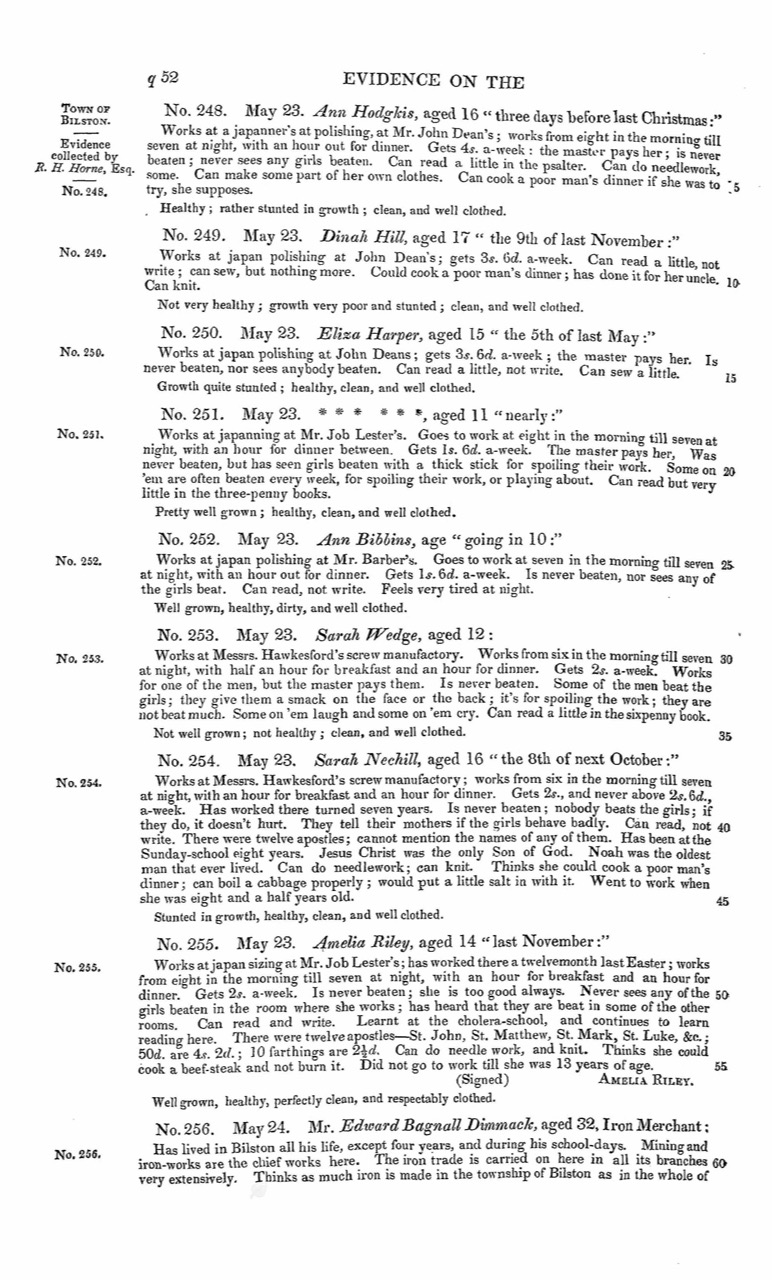
No. 256. May 24.
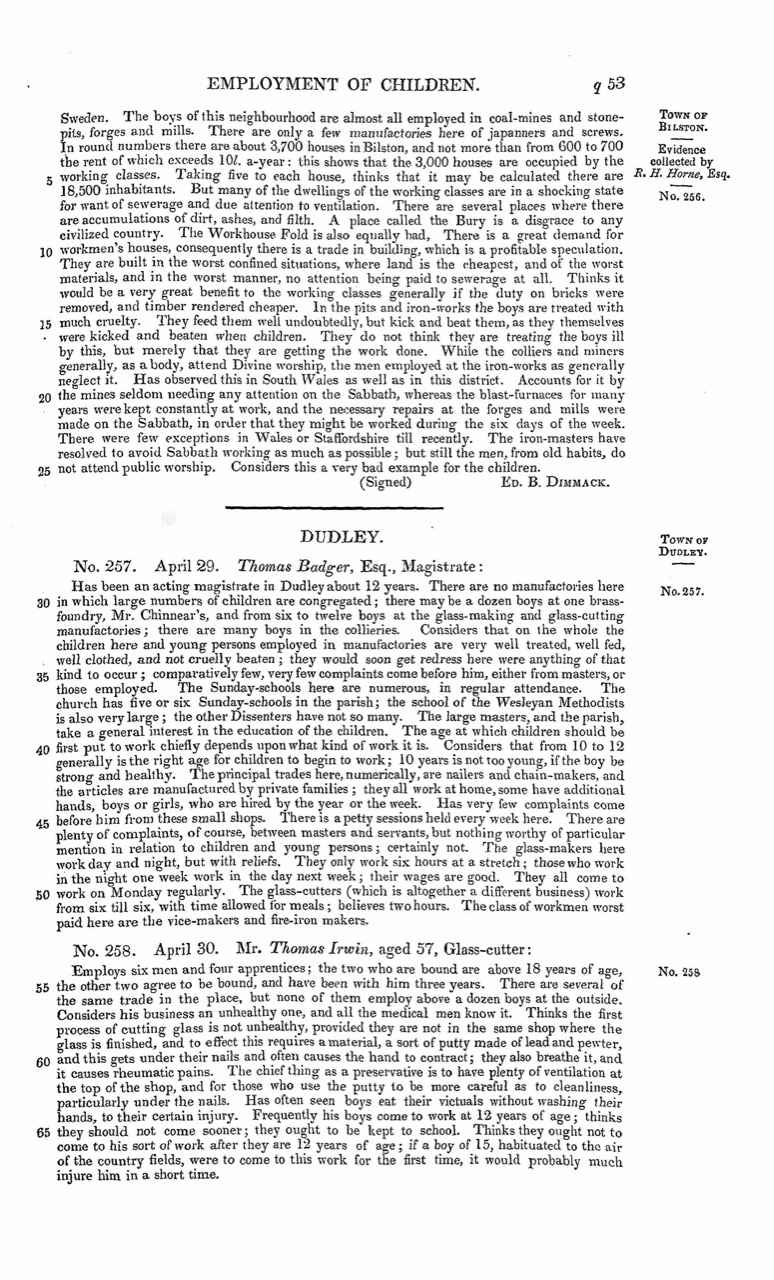
Mr. Edward Bagnall Dimmack, aged 32, Iron Merchant:Has lived in Bilston all his life, except four years, and during his school-days. Mining and iron-works are the chief works here. The iron trade is carried on here in all its branches very extensively. Thinks as much iron is made in the township of Bilston as in the whole of Sweden. The boys of this neighbourhood are almost all employed in coal-mines and stone-pits, forges and mills. There are only a few manufactories here of japanners and screws. In round numbers there are about 3,700 houses in Bilston, and not more than from 600 to 700 the rent of which exceeds 10l. a-year: this shows that the 3,000 houses are occupied by the working classes. Taking five to each house, thinks that it may be calculated there are 16,500 inhabitants. But many of the dwellings of the working classes are in a shocking state for want of sewerage and due attention to ventilation. There are several places where there are accumulations of dirt, ashes, and filth. A place called the Bury is a disgrace to any civilized country. The Workhouse Fold is also equally bad, There is a great demand for workmen’s houses, consequently there is a trade in building, which is a profitable speculation. They are built in the worst confined situations, where land is the cheapest, and of the worst materials, and in the worst manner, no attention being paid to sewerage at all. Thinks it would be a very great benefit to the working classes generally if the duty on bricks were removed, and timber rendered cheaper. In the pits and iron-works the boys are treated with much cruelty. They feed them well undoubtedly, but kick and beat them, as they themselves were kicked and beaten when children. They do not think they are treating the boys ill by this, but merely that they are getting the work done. While the colliers and miners generally, as a body, attend Divine worship, the men employed at the iron-works as generally neglect it. Has observed this in South Wales as well as in this district. Accounts for it by the mines seldom needing any attention on the Sabbath, whereas the blast-furnaces for many years were kept constantly at work, and the necessary repairs at the forges and mills were made on the Sabbath, in order that they might be worked during the six days of the week. There were few exceptions in Wales or Staffordshire till recently. The iron-masters have resolved to avoid Sabbath working as much as possible; but still the men, from old habits, do not attend public worship. Considers this a very bad example for the children.
(Signed)
Ed. B. Dimmack.
Sources and Notes
- The groundswell of opinion against the working conditions of children was part of a series of Factory Acts many initiated by the Tory Peer Anthony Ashley Cooper.
- The full text of the 1842 Commission Report is available on ancestry.com
- A strong critique of the commission’s evidence was made on the front page of the Wolverhampton Chronicle, Weds 13 May 1843. It states that Mr R H Horne, the interviewer, had grossly exaggerated and maligned the town of Bilston, countering these accusations by listing the existence of the numerous and diverse local schools in operation. In particular the article seems to cite Mr E B Dimmack (Evidence No 256) as a reason for a more positive outlook.