The outbreak of the English Civil War from 1642 onwards spurred the growth of a new phenomenon of militant ‘Puritan’ preachers, many of them Welsh. This article talks about how three such preachers came to have an impact on the family history in the small and somewhat remote Chiltern village of Turville.
Richard West, baptised in Turville on 5 Jan 1605/6, was a yeoman, with some reasonably sized landholding in the country around Turville. The steep and wooded hillsides were mainly used for wood, coppicing and charcoal. Some of these products were shipped to London from quays down the Hambledon valley in Henley. Richard and his wife Elizabeth must have married in about 1630 and we can deduce that they were strongly Puritan in their outlook. Their second oldest daughter Elizabeth married Peter Toovey, the main descendant line followed on this website.
But it is their oldest daughter Mary (bap 8 Apr 1632, Turville) whose marriages show us that by the 1650s the West family were moving in ever higher echelons of radical religious thinkers behind the English Revolution. This happenstance must primarily have been brought about by geography but we should not underestimate the force of deeply held religious beliefs, awakened by the seismic events around the Civil War.
Over in Stokenchurch a few miles away, Henry Owen, a Welshman, had been a schoolmaster in the 1610s, and it was his son John Owen who became the leading Puritan Theologian under Oliver Cromwell. John Owen was born in Stadhampton, Oxfordshire in 1615 and went on to study at Queen’s College, Oxford, matriculating 4 Nov 1631. The initial skirmishes of the Civil War indeed took place at sites like nearby Chalgrove but eventually the Royalists took control of Oxford and academics, like John Owen, fled towards London and up to the Chiltern hills. Stokenchurch and Wendover became important havens.
At his estate in Wormsley, Sir Adrian Scrope, later regicide, represented an area under strong Parliamentary control. To the north at Hampden House, John Hampden, the most eminent of Parliamentary leaders, also held sway.
Stokenchurch was on the main Oxford road and although still in the diocese of Oxford was surrounded by territories that formed part of the diocese of Lincoln, such as Turville. It is through the travels up and down this main arterial land route that the story unfolds.
Mary West, the oldest daughter of Richard West, has to have been acquainted with visitors and she seems to have taken up as a maid for the wife of a Welsh man called Wroth Rogers in perhaps 1648. Wroth Rogers was named after the inspirational Welsh preacher William Wroth, the rector of Llanvaches in Monmouthshire. On the latter’s death in 1641, the mantle of this group of Llanvaches ‘faithful’ fell to a man called Walter Cradock. Wroth Rogers was at the centre of this group, fleeing with them, and eventually taking up arms in the New Model army. He went on to became a colonel and finally Parliamentary Governor of Hereford.
It is through the household of Wroth Rogers that Mary West came to meet and marry her husband Richard Delamaine. We know a lot of these details because of a pair of polemical pamphlets published in Hereford around 1654.
Richard Delamaine was about 20 in 1649 and probably eager to be a theology student in Oxford at the time. He may also have spent time in Emmanuel College, Cambridge. Later to his discredit, we know he never formally matriculated, let alone received a degree, but he was by all accounts a formidable preacher. His father had been a Mathematician at the court of Charles I but was to die probably in battle for the Parliamentary cause in 1645. The young 15 year old Richard, who was now fatherless, had a keen interest in the new theology and must have come in contact with the group of radical Llanvaches Puritans, probably in London. Some of these were Fifth Monarchists but a key individual he met was Wroth Rogers. This group of Welsh Puritans had fled Llanvaches in Wales in 1642, first to Bristol in 1643 and then to London in 1645. At the time they came to be centred on All Hallows the Great in London.
It would seem that some time in 1649-50 Richard Delamaine, aged 21, thus joined up with Wroth Rogers primarily in a military capacity. Perhaps a little later, he must also have married Mary West, then in the service of the Rogers household. They were tumultuous times and it is difficult to disentangle the sequence of events.
We learn from the later pamphlets between Richard Delamaine and Silas Taylur in Hereford that Richard had taken as a wife the servant of Cecilia Rogers (nee Jones), the first wife of Wroth Rogers. This was evidently meant as an insult by Silas Taylor. The will of Richard Delamaine in 1657 nonetheless shows that his main wealth was held in land in Turville and he had purchased it from Richard and Elizabeth West (sic).
So by these circumstances, a young girl from Turville found herself in 1653 the wife of an erstwhile soldier and now polemical preacher in Hereford Cathedral and also by then, the mother of two young children, Wroth and Elizabeth Delamaine.
Wroth Rogers served in the Barebones Parliament, the so-called Parliament of Saints. He survived the Restoration but Richard Delamaine died in 1657. His will makes it clear, he was suffering from ‘the pain and anguish of sickness’.
Sometime after Richard Delamaine’s death, the widow Mary remarried another radical preacher James Forbes, a Scotsman, and moved to Gloucester. Both James and Mary suffered heavy persecution after the Restoration and James Forbes, a Congregationalist, was imprisoned on more than one occasion. Mary died and was buried in St Michaels, Gloucester, 17 Aug 1687.
Meanwhile her sister Elizabeth had stayed in Turville and had married Peter Toovey. They formed part of a strong ‘Puritan’ community in Turville increasingly centred around Elizabeth West, the mother-in-law to both Peter Toovey and James Forbes. She had been widowed in 1654. She was later to become a prominent Quaker.
Although we can catch a few glimpses of what was going on in Turville in the 1650s from the fragmented Parish Register, things all come a little clearer as they wind out in the early 1660s and the retribution comes. St Mary’s appears to have had a succession of radical ministers in the interregnum culminating in the ‘Restoration’ appointment of the very young Richard Morgan as Vicar in 1662/3.
The 1662 episcopal ‘visitation’ into dissent in Buckinghamshire led by the Bishop of Lincoln went parish by parish. Attached is the transcript in Latin of the case brought against Peter Toovey. We can suppose that failure to baptise children was very much a stand in principle and something that a Quaker may well have held to. Peter Toovey was excommunicated from the church for this on 12 Nov 1663. This is conveyed by the simple abbreviation (ex. meaning ‘excommuncatur=he was excommunicated”). His mother-in-law Widow West suffered the same punishment with the same date.
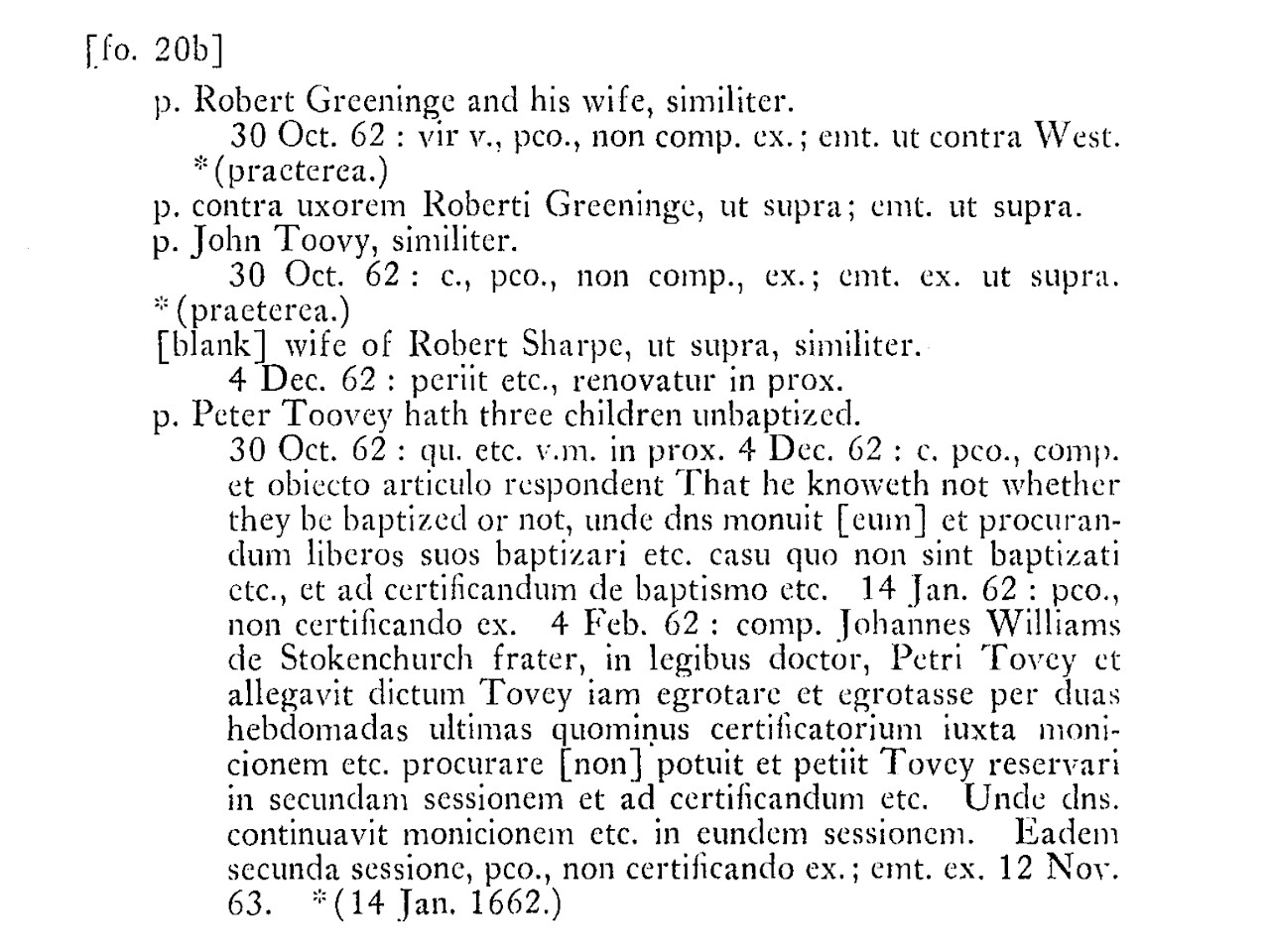
Extract from Episcopal Visitation Book for the Archdeaconry of Buckingham, 1662
However, we know from further reports from Richard Morgan in 1669 that attendance at the main church in Turville continued to be poor. Sunday worship was dominated by the conventicle held in Widow West’s house, sometimes attended by over 100 people.
The passage about Peter in this ‘visitation’ explains that he is too sick to carry out his duties (egrotare) but it is the intervention of a Dr John.Williams that is striking here. Of all the John Williams’s listed in the Oxford Alumni in the 1630s one jumps out as fitting the bill and matches the sequence of preachers described above.
John Williams himself is found in London in 1663, the next year, where he is arrested and put on trial. The correspondence used against him in his trial shows that he was almost certainly working clandestinely still with John Owen and both were part of the transient non-conformist household of Charles Fleetwood in Stoke Newington.
Sources and Notes
- Will of Richard Delamaine, Probate 14 Aug 1657, PCC.
The ‘purchase’ of land from his in-laws is difficult to interpret but there were massive land transaction and sequestrations going on at the time (pre 1654 the date of death of Richard West). - Anthony Wood, Athenae Oxoniensis, ed. Philip Bliss, 1813–20, IV, col. 97
- Henry Owen’s role as schoolmaster before becoming Vicar of Stadhampton is listed.
- Abstract Will of William Wroth written 27 Sep 1638 (FMP).
- Herbert Walter, Preacher, Executor;
- Wroth Rogers is a named witness.
- Will of Peter Toovey, Probate 17 Jul 1668, PCC.
Names Mr James Forbes, his beloved brother, as executor. - DX 977 Buckinghamshire Archives.
Shows some of the land transactions between Peter Toovey, Richard West and Richard Delamaine. - Will of Peter Toovey, Probate 17 Jun 1743, PCC.
Confirms James Delamaine, son of Wroth Delamaine and grandson to Richard, is a cousin. - Wroth Rogers’s son Nathan Rogers wrote a book in 1695 ‘Memoirs of Monmouthshire’ that covered the flight of the Puritans from Llanvaches 1642-1645. This involved his father and mother and some insights into their life then.
- Historical Journal CUP 21 Feb 2025 “John Owen, Puritan Politics, and the Fall of the Cromwellian Protectorate”.
Mentions interaction between James Forbes and John Owen and attitudes to Richard Cromwell, 1658. - Pamphlet Entitled: “Impostor magnus, or The legerdemain of Richard Delamain now preacher in the city of Hereford. Being a narrative of his life and doctrine since his first coming into that county. Faithfully collected and published by one that will assert the truth of each particular” written by Silas Taylor, Printed London 1654.
- Pamphlet Entitled: “The close hypocrite discovered; or A true description of the life and person of Cap. Taylor in the City of Hereford” riposte written by Richard Delamain, Printed London 1654.
- Buckinghamshire Record Society Episcopal Visitation Book for the Archdeaconry of Buckingham, 1662.
- Buckinghamshire Record Society Buckinghamshire Dissent and Parish Life, 1669-1712.
- Turville Parish Register (Bucks Archives, Aylesbury) in scribbles at the back helps to give an implied list of Interregnum ministers/clerks. Below is my working list (not available in CCED)
- Roger Gibson (possibly father succeeded by son of same name from 1582);
- Robert Rogers 1640;
- John Toovey 1644;
- William Keene 1652;
- John Randall 1658;
- John Toovey (again) 1661;
- Richard Morgan 1663.
- Charles Fleetwood was Oliver Cromwell’s son in law.