This article looks at some evidence as to how the upper middle class car-owning Downing family of 16 Woodbourne Road Edgbaston responded to the General Strike.

Pamela and Hazel Downing, Jul 1926
A general strike was called on May Day 1926, due to start at one minute to midnight on 3 May 1926, in support of locked out miners.
On 1 May there had been a very large Trade Union and socialist rally in central Birmingham, at which the charismatic Oswald Moseley, then leading Labour politician, spoke as the clamour for strike action grew.
The diary of Molly Downing recalls how her sister, Phyllis, left by train for London on Monday 3 May. The next day she states ‘First day of strike – no trains, no London papers’. She is preoccupied with her newborn, Jill, not yet three months old. The Downings owned a car and it is clear that mitigated against any difficulties in Noel Downing getting to his work and meant that they were in demand to assist a wide range of people. Molly talks about engagements cancelled and comments that the strike is ‘improving’ meaning quite clearly that things were able to operate more normally.
It is of particular interest to note her comments on the activities and whereabouts of her husband, Noel. He had voluntered to become a Special Constable probably as soon as the State of emergency was called. It is written that on the first day of the strike he ‘motored into Birmingham’ probably on business. Later on it talks about him being on ‘Motor Patrol’. It would seem his duties were usually about four hours per day and he could be called to go anywhere in the Birmingham area and was summoned by telephone – messages often taken by Molly who was at home with her three children.
On 5 May, the second day of the strike it says ‘Noel on transport’ and later on in the evening it says ‘Noel called out’.
On 8 May, a Saturday, it states ‘Noel out to Broad Street crowds but orderly’ he was ‘called for transport’ later.
On Sunday 9 May, Noel was with the police at Ladywood all afternoon apparently at the Police Station there. Molly took Robey, the bull terrier, for a walk down Hagley Road “to see the strike” but was home for tea with the children. Noel was ‘called out again to the Town Hall’ but was back again for supper.
On Monday 10 May, Molly notes services returning with a letter from Phyllis. ‘Buses run (merrily) by university students’. Noel was home for lunch but again on motor patrol duty on Hagley Road. Later after tea, she notes, he was out to see “the buses in”.
On Tuesday 11 May, Noel was again on motor patrol in his police garb, this time apparently in Aston. Pam was unable to go to school this day.
On Wednesday 12 May the diary states ‘strike off’ – but notes there was again no post and Noel was again on motor patrol.
On Thursday 13 May Noel was again at Aston Police Station.
By Friday 14 May the diary states ‘strike second settlement’ and the strike was now in full retreat.
For his two weeks service Noel, cited as “William Downing”, received both a certificate from No 10 Downing Street and also from the Birmingham Watch Committee. (see below)
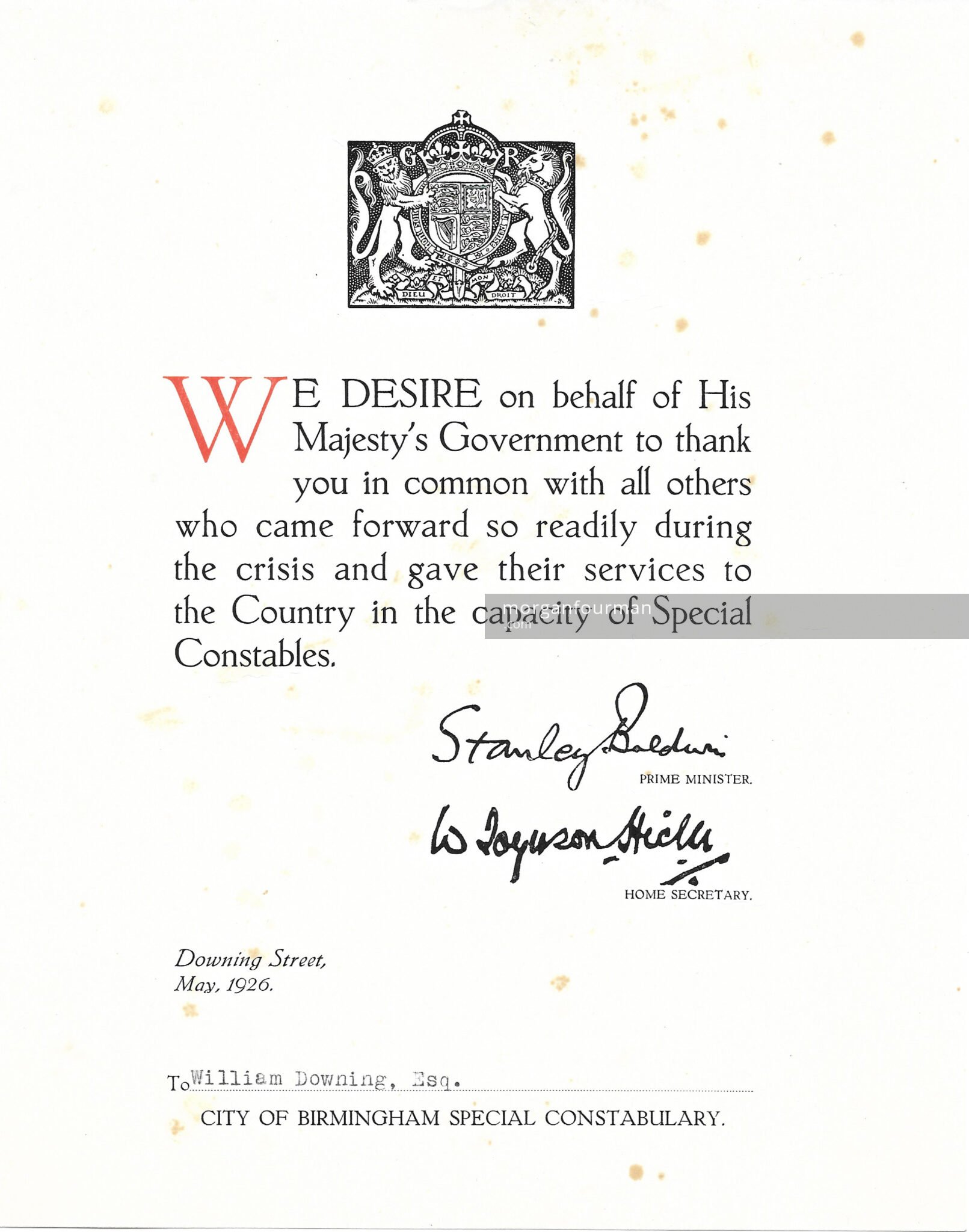
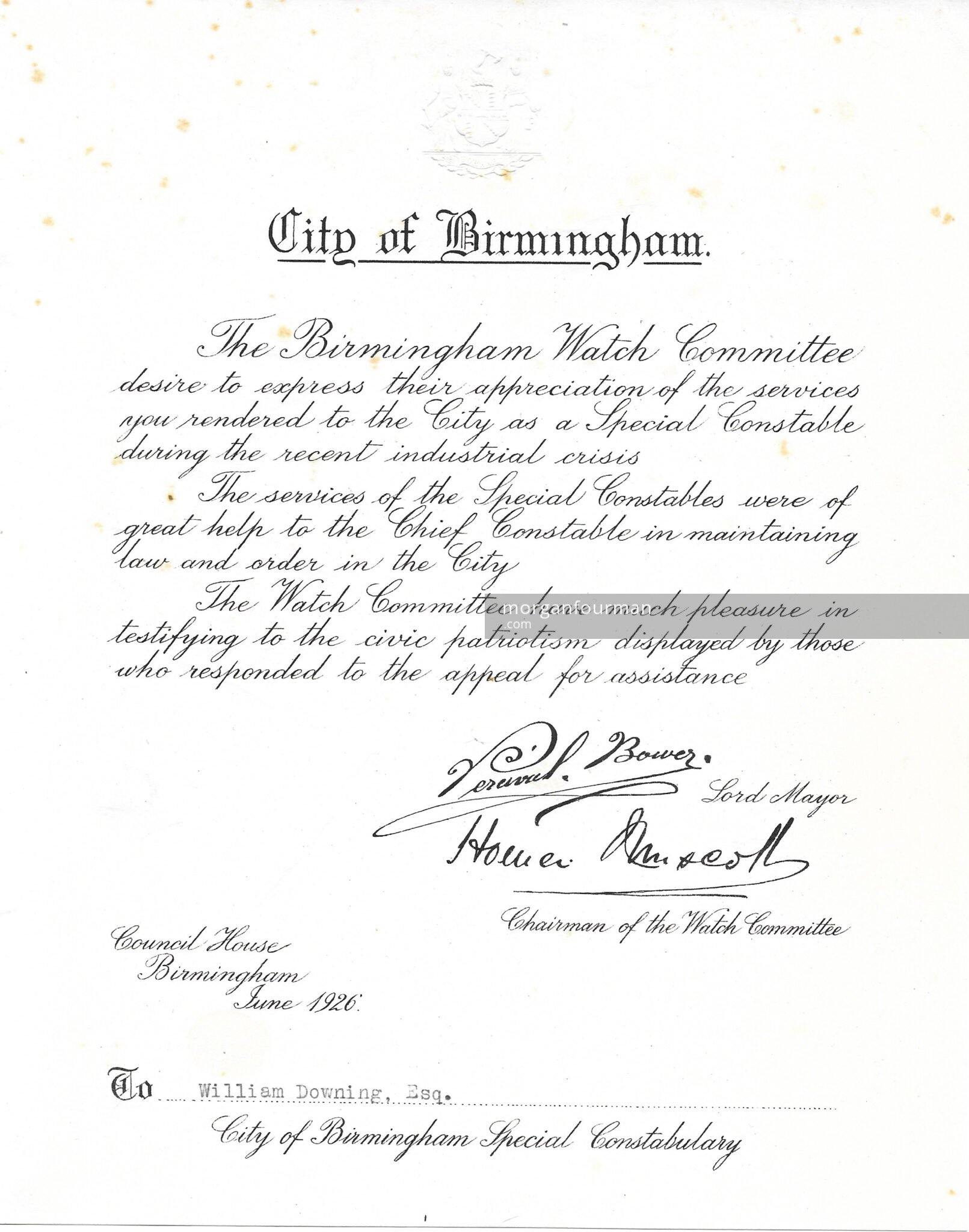
By July the kit that had been issued to Noel, an armband, police cap, whistle and truncheon were probably due to be returned. His two young daughters were pictured dressing up with them in the garden of 16 Woodbourne Road.
However, it would appear that Noel stayed in the Special Constabulary until 1945, when he finally moved from the Birmingham area. He received a medal and long service awards.
Sources and Notes
- Molly Downing’s diary 1926
- Phyllis Evans diary, 1926
- It is not clear when Noel signed up and was sworn in as a Special Constable. On Saturday 1 May, Molly stated he wanted to go fishing but it was raining heavily. That suggests he was not directly involved until after the State of Emergency was declared on the evening of May 1, 1926. The vast majority of Specials were sworn in on 2nd and 3rd May and we must presume this is when Noel signed up – though there is no mention of it in his wife’s diary
- On Friday 7 May the Police raided the Communist Party Headquarters, responsible for publishing ‘The Birmingham Worker’. This was based in 260 Broad Street, Birmingham. The reason that Special Constables, like Noel, were sent to Broad Street the following day seems obvious
- Tensions continued on 9 May in Ladywood. This was Neville Chamberlain’s parliamentary seat, where he had defeated Oswald Moseley by a slender 77 votes in the 1924 General Election
- Problems in Aston after the end of the strike appear to have continued as many tramworkers refused to go back to work, with intimidation and victimisation of strike breakers a major issue